RoostGPT Overview
RoostGPT is Roost's AI-powered test generation engine. It uses large language models to generate unit, API, functional, and integration tests from your source code, API specifications, and business requirements.
Supported Test Types
| Test Type | From | Generates |
|---|---|---|
| Unit Tests | Source code files | JUnit, pytest, Jest, and other framework tests |
| API Tests | Swagger / OpenAPI spec | Postman collections, Karate tests, Rest Assured |
| Functional Tests | Jira / Azure DevOps user stories | Gherkin feature files, test scenarios, API specs |
| Integration Tests | API spec + Gherkin feature file | End-to-end test suite with CSV test data |
| UI Tests | Application URLs, natural language requirements, Word/PDF/Excel | Playwright test suites with POM architecture, PDF reports, Gherkin output |
Supported AI Providers
| Provider | Unit / API / Functional / Integration | UI Tests |
|---|---|---|
| OpenAI | ✅ | ✅ |
| Azure OpenAI | ✅ | ✅ |
| Anthropic Claude | ✅ | ✅ |
| Google Gemini | ✅ | ✅ |
| AWS Bedrock | ✅ | ✅ |
See AI Provider Support for model-level details.
Supported Git Platforms
- GitHub (Cloud & Enterprise Server)
- GitLab (Cloud & Self-hosted)
- Bitbucket (Cloud & Server/Data Center)
- Azure Repos / Azure DevOps
Deployment Options
| Option | Description |
|---|---|
| Cloud | Hosted at roost.ai — no setup needed |
| Self-hosted Ubuntu | Run on your own server using the deployment tool |
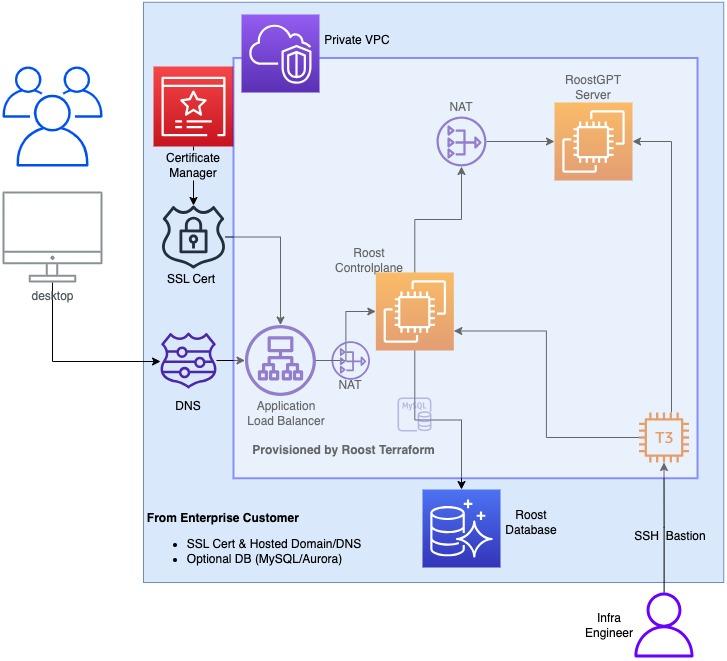
| Self-hosted AWS (Terraform) | Full infrastructure provisioned via Terraform scripts |
| CLI (Stand-alone) | Install and run on any Linux/macOS/Windows machine |
| IDE Plugin | VS Code Marketplace |
Interfaces
RoostGPT is available as a Web UI, CLI, IDE Plugin, and API. Each interface suits different workflows. See Choose Your Interface for a full comparison.
Architecture
The hosted RoostGPT stack consists of:
- API Server — Receives requests, manages job queues
- Test Generation Workers — Isolated Docker containers per test job
- Database — Stores configurations, connectors, history, and audit logs
- Webhook Listener — Receives Git events (push, PR, release) and triggers generation
Next Steps
- Multiple Test Flow — Full walkthrough from Jira story to integration test
- AI Provider Support — Models and pricing
- Unit Test Generation — How unit tests are generated
- UI Test Generator — Autonomous Playwright test generation from any URL